
Last Updated:
David Lloyd vs Virgin Active (2026): Full Price & Facilities Comparison
David Lloyd and Virgin Active are two of the UK’s best-known premium health and fitness club brands, and they’re the two names people most often cross-shop when deciding whether a budget gym isn’t enough. Both offer gyms, swimming pools, spa facilities, and group exercise classes — but they’re built around genuinely different priorities, and the right answer depends heavily on what you’ll actually use and where you live. This guide compares real pricing, facilities, discount schemes, and member experience so you can make an informed choice.
Which Club Is Right for You: David Lloyd or Virgin Active?
Both are health-club brands rather than budget gyms, so the difference comes down to scale, racquet sports, and how the contract works.
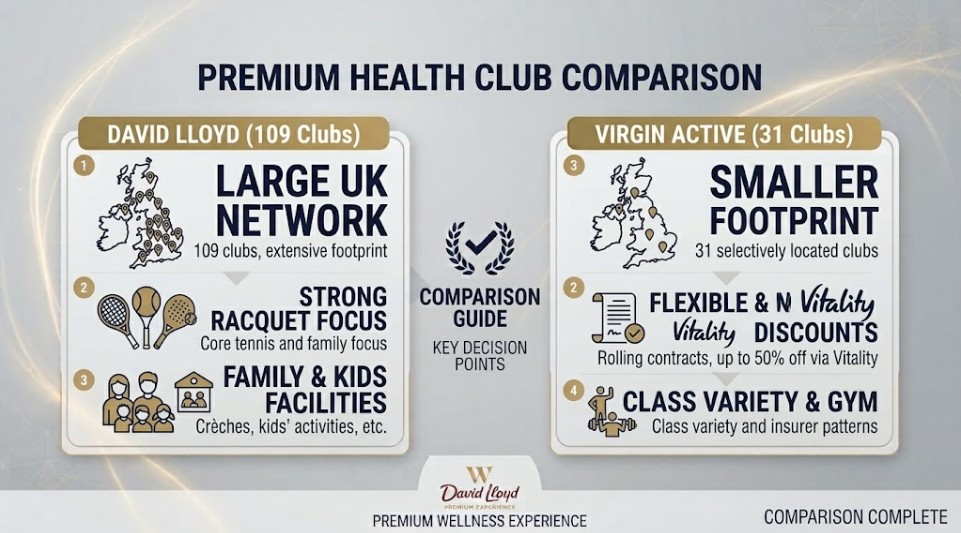
- David Lloyd: 109 clubs in the UK, with a strong tennis and family focus.
- Virgin Active: a much smaller UK footprint of 31 clubs (per its November 2024 access guide).
- Pick David Lloyd if racquets, a spa and kids’ activities decide your week.
- Pick Virgin Active if you want a lower likely monthly price and a rolling contract option.
David Lloyd and Virgin Active overlap heavily on price, and neither is consistently cheaper — it depends entirely on your specific club. As a general pattern: David Lloyd tends to win on racquet sports and family facilities (tennis, squash, padel, crèches, and kids’ clubs are core to its model), while Virgin Active tends to win on class variety, gym equipment, and insurer discounts — Vitality Health Insurance members can get up to 50% off Virgin Active membership, a discount David Lloyd doesn’t match at the same scale.
How Much Do David Lloyd and Virgin Active Cost in 2026?
Neither chain posts fixed prices, because each club quotes its own rate. The ranges below are indicative only.
| Typical Price | David Lloyd | Virgin Active |
|---|---|---|
| Typical adult monthly range | Roughly £80–£170+ for individuals; premium tiers reported higher | Roughly £70–£110 reported for one club (Norwich) |
| Top-tier reported cost | Diamond reported at £200–£280+ | Not reliably reported |
| Joining fee | Reported £50–£150; £60 on Vitality’s Platinum offer | Typically up to £50; £75 at Classic Collection clubs |
| Source quality | Third-party, member-reported | Third-party, single club |
- David Lloyd’s own site says costs differ from club to club and by membership type.
- Reported David Lloyd tiers run Plus, Platinum and Diamond, and one guide puts Platinum at £130–£230 a month.
- Virgin Active’s joining fee is typically up to £50, or £75 at Classic Collection clubs.
- Always ask for the quote in writing before you sign.
Price depends heavily on the contract you sign, which is the next thing to compare.
What Contract Options and Cancellation Terms Does Each Club Offer?
Contract length changes your real monthly cost as much as the tier does.
- David Lloyd: you can join on a 3-month trial basis or go straight to an initial 12-month contract.
- Virgin Active: a 12-month deal gives reduced monthly payments compared to the rolling monthly membership.
- Virgin Active’s rolling plan can be ended at any time with a month’s notice.
- Virgin Active also offers discounted memberships for ages 16–25 and over 65s.
- Real-world example, David Lloyd: in early 2026 it trialled a “signature” tier at six clubs, charging an extra £140 a month for next-day tennis booking, ending 31 March 2026. A petition against it drew 360+ signatures.
Once you know the commitment, compare what the money buys.
Facilities Compared | David Lloyd vs Virgin Active
David Lloyd and Virgin Active are both premium health club chains in the UK, but they cater to different styles of working out and lifestyle needs.
Gym floor and equipment
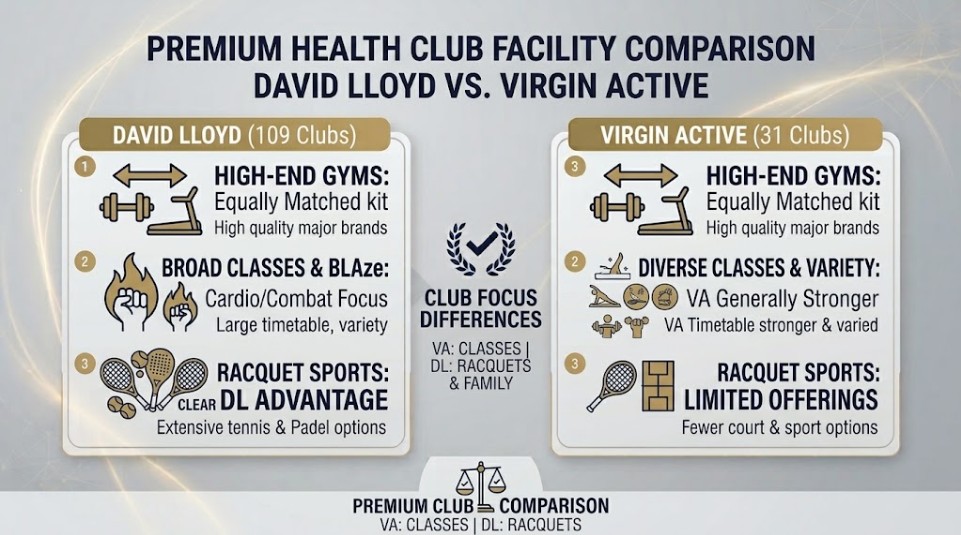
Both brands invest in high-end equipment from major manufacturers, and neither is a meaningful step up from the other on raw kit quality — this is genuinely one of the more evenly matched categories.
Group fitness classes
Virgin Active is generally considered to have a slightly stronger and more varied class timetable, with strong Pilates, HIIT, and strength training programming aimed at members of all experience levels. David Lloyd’s signature offering is Blaze, a cardio/strength/combat-style class, alongside a broad standard timetable — strong, but historically slightly less varied than Virgin Active’s.
Racquet sports
This is David Lloyd’s clearest advantage. Many David Lloyd clubs have extensive tennis provision — some locations offer well into double figures of courts, plus squash, badminton, and a growing number of padel courts — with coaching available. Virgin Active’s racquet sports offering is thinner across the network; some clubs have squash courts, but dedicated tennis facilities are far less common.
Swimming pools
Both brands typically offer indoor pools, with many David Lloyd clubs also including outdoor pools — a differentiator worth checking locally, since it varies club by club on both sides.
Spa and wellness
Both offer sauna, steam room, and whirlpool-style facilities as standard, with select clubs on both sides offering more elaborate “Spa Retreat” style upgrades, Himalayan salt saunas, or cold-therapy features like plunge pools and ice baths. Physiotherapy is available at select clubs from both brands, though rival health-focused chains like Nuffield Health tend to have deeper physiotherapy integration than either.
Family and kids’ facilities
This is David Lloyd’s other clear strength. Crèches, supervised kids’ clubs, family swim sessions, and — at many clubs — dedicated soft play areas are core to the David Lloyd model. Virgin Active’s family provision is considerably thinner; most clubs are built more around adult fitness and class culture than family days out.
How Do the Companies Compare?
David Lloyd and Virgin Active are similarly priced premium health club chains, but they cater to different priorities: David Lloyd focuses on racquet sports and family facilities, while Virgin Active emphasizes city-centre locations, classes, and fitness.
| Qualities | David Lloyd Clubs | Virgin Active |
|---|---|---|
| Industry | Sports & Recreation | Beauty & Wellness |
| Revenue | Hidden by employer | Hidden by employer |
| Employees | More than 10,000 | 1,001 to 5,000 |
| Headquarters | Hatfield, East of England | London |
How Do Their Employee Ratings Compare?
Virgin Active scores higher overall than David Lloyd Clubs on aggregate job platform comparison metrics.
| Category | David Lloyd Clubs | Virgin Active |
|---|---|---|
| Overall | 3.1 | 3.6 |
| Work-life balance | 3.0 | 3.3 |
| Compensation and benefits | 2.9 | 3.0 |
| Job security and advancement | 2.9 | 3.2 |
| Management | 2.7 | 3.2 |
| Culture | 3.1 | 3.6 |
Virgin Active leads on every measure.
Which Club Gives Better Value for Money?
Neither David Lloyd nor Virgin Active is universally better for value; the right choice depends on your specific location, whether you play racquet sports or have children, and if you qualify for health insurance discounts.
- Heavy racquet users usually get more from David Lloyd.
- Gym-and-class users often pay less at Virgin Active.
- Vitality members can get up to 50% off flexible monthly fees at either brand, with a joining fee.
- Real-world example, Vitality: one health-insurance perk covers Virgin Active, Nuffield Health or David Lloyd, but only one discounted membership per adult.
- Day or trial passes cost far less than a year’s mistake.
What Is It Like to Work at David Lloyd Clubs vs Virgin Active?
Staff morale shapes cleanliness, class cover and member service. Indeed’s comparison data (as supplied) shows these gaps.
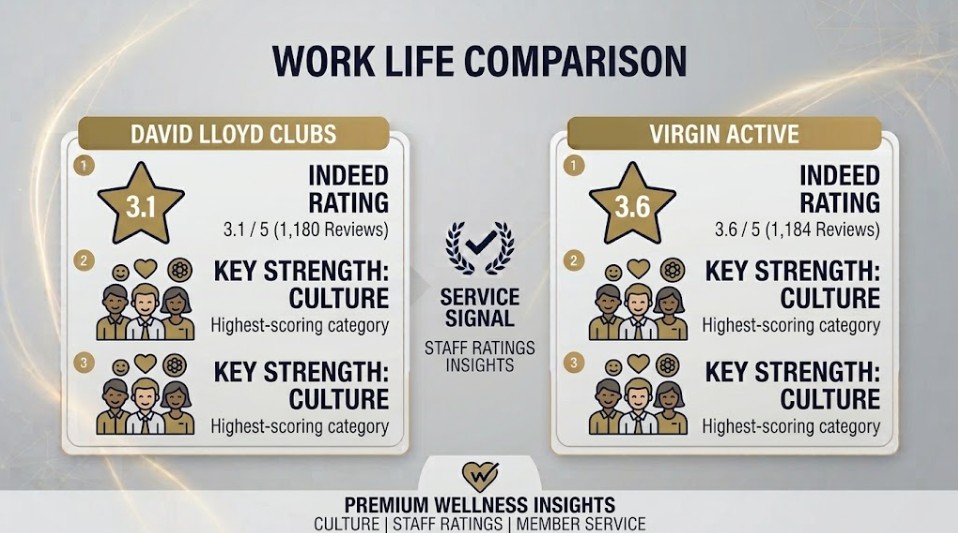
- David Lloyd Clubs holds a 3.1 rating from 1,180 reviews.
- Virgin Active holds 3.6 from 1,484 reviews.
- Both score highest on culture.
- Treat staff ratings as a service signal, not a verdict on the club.
Insurance & Discount Schemes | David Lloyd vs Virgin Active
One of the most practically important differences between the two brands is how they interact with UK private health insurance.
Virgin Active and Vitality
Vitality Health Insurance members can receive up to 50% off Virgin Active membership, with the discount scaling based on tracked activity levels through the Vitality app. For an eligible member, this can turn a £130/month membership into roughly £65/month — a genuinely significant saving that has no direct equivalent on the David Lloyd side.
David Lloyd and insurer/employer schemes
David Lloyd offers discounts through some employer corporate schemes and select health insurance wellness partnerships (such as Aviva and Bupa), plus Blue Light Card discounts for NHS and emergency services staff — but none of these typically approach the scale of Virgin Active’s Vitality discount.
Practical takeaway: if you already hold Vitality health insurance, the effective price gap between the two brands can shift dramatically in Virgin Active’s favour. If cost is close either way, checking your existing insurance policy for a gym discount before deciding is one of the highest-value five minutes you can spend.
What Do Employees Think of the CEOs and Pay?
Employee sentiments and compensation structures differ notably between David Lloyd Clubs and Virgin Active based on aggregate review platforms like Glassdoor and Indeed.
- CEO approval: 42% approve of Russell Barnes (David Lloyd Clubs); 53% approve of Dean Kowarski, Group CEO (Virgin Active).
- Salary satisfaction: 35% think they are paid fairly at David Lloyd Clubs; 29% at Virgin Active.
- Higher CEO approval at Virgin Active does not translate into higher pay satisfaction.
What Do Current Employees Say in Reviews?
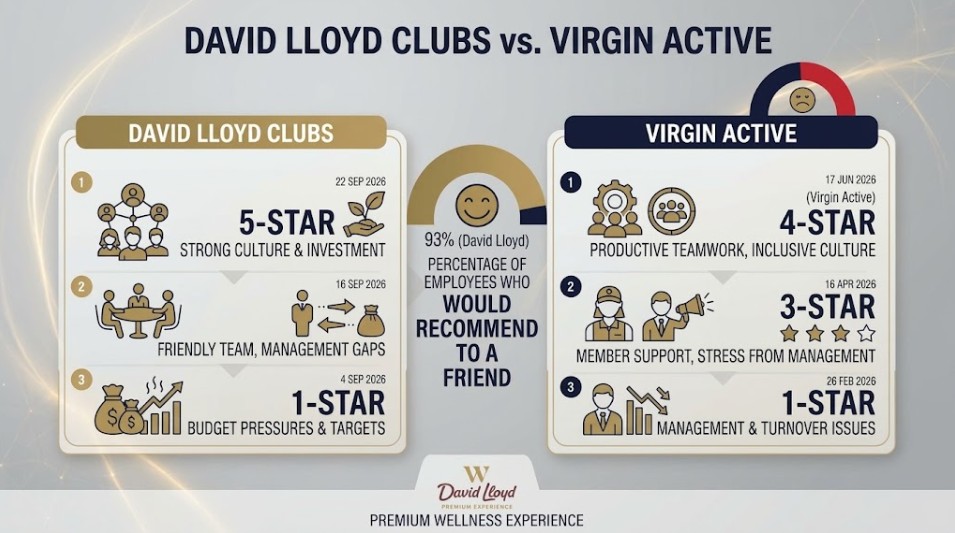
When evaluating workplace sentiment between the UK’s top premium health club chains, current employees report higher overall satisfaction at David Lloyd Clubs compared to Virgin Active. Glassdoor data reveals that 93% of David Lloyd employees would recommend the company to a friend, whereas only 47% to 49% of Virgin Active employees say the same.
David Lloyd Clubs
- 5.0 (22 Sep 2026), “David Lloyd is a second home”: a Data Analyst praises a strong, ingrained culture and investment in their growth.
- 3.0 (16 Sep 2026), “Work life balance ok”: friendly colleagues, but managers pass responsibility between themselves.
- 1.0 (4 Sep 2026), “Awful”: budgets cut while membership prices rose and profit targets climbed, creating pressure.
Virgin Active
- 4.0 (17 Jun 2026), “Productive, fast paced and great teamwork”: a Membercare employee in Nottingham describes a structured day, clear hierarchy and an inclusive culture.
- 3.0 (16 Apr 2026), “stay as frontline staff mot management”: members and certain managers are the best part; the stress comes from being asked to do more.
- 1.0 (26 Feb 2026), “Terrible management, high staff turnover”: a Families Assistant in London cites weak support and weekend gaps.
Beyond the marketing, genuine member opinion on this comparison is notably split. On UK consumer forums, some members describe David Lloyd as considerably pricier without a corresponding jump in quality, while others who have used both over several years describe David Lloyd as the more upmarket experience — particularly newer clubs with recent spa or pool investment.
A recurring theme is that David Lloyd’s pricing is far less transparent upfront than Virgin Active’s, with several members noting they had to enquire directly or visit in person to get a real quote, whereas Virgin Active more commonly displays indicative pricing. This lines up with our own research experience — David Lloyd pricing genuinely requires more digging to pin down than Virgin Active’s.
David Lloyd vs Virgin Active by Location
Because both brands price by club rather than nationally, a meaningful comparison is almost always local, not national. In cities where both brands operate near each other, it’s worth directly comparing:
- The exact monthly rate at your nearest club of each brand
- Whether the David Lloyd club has strong racquet sports provision, since that’s where its premium is best justified
- Whether you hold Vitality, Aviva, or Bupa insurance, since the effective price can shift meaningfully once a discount is applied
- Off-peak options at both brands if your schedule allows quieter-hours access, since both offer meaningfully reduced off-peak rates
In some cities, only one of the two brands operates at all — worth checking before assuming a direct comparison is even possible where you live.
Which Should You Choose?
You should choose David Lloyd if you need racquet sports, family amenities, and extensive spa facilities, or Virgin Active if you want strong group classes and hold Vitality health insurance for up to 50% off membership.
Choose David Lloyd if:
- You play tennis, squash, padel, or badminton regularly and want courts and coaching included
- You have children and want a genuine family day-out venue, not just a gym with a creche as an afterthought
- You value an all-in-one destination — gym, pool, spa, sport, and social space — over pure fitness efficiency
Choose Virgin Active if:
- You hold Vitality health insurance and can access the up-to-50% discount
- Group fitness classes and instructor variety matter more to you than racquet sports
- You want more transparent, easily comparable pricing before you commit to a tour or enquiry
- You don’t have children, or don’t need club-based childcare as part of your membership
Consider neither if:
- You only need basic gym-floor access a few times a week — a budget gym like PureGym or The Gym Group will cost a fraction of either brand’s price
- You’re on a strict budget and won’t realistically use the pool, spa, or class timetable that justifies the premium at either club
Pros and Cons: David Lloyd vs Virgin Active
David Lloyd excels in racquet sports and family facilities, but has higher costs and strict cancellation policies. In contrast, Virgin Active offers strong fitness class timetables and health insurance discounts, but has fewer tennis courts and limited family care.
| David Lloyd | Virgin Active |
|---|---|
| Pros: Strong racquet sports, family/kids facilities, all-in-one destination feel | Pros: Strong class timetable, generally more transparent pricing, major Vitality insurance discount |
| Cons: Pricing often not published upfront, less class variety at some clubs | Cons: Weaker racquet sports and family provision, pricing varies sharply by London postcode |
What Practical Tips Help You Choose Between Them?
These practical tips will help you in choosing the right option between them.
- Ask both clubs for a written quote including the joining fee.
- Visit at your normal training time to check how busy it feels.
- Take a trial or day pass before committing to 12 months.
- Check your exact club’s facilities list, since sites vary.
- Look at the cancellation notice period, not just the monthly price.
- Ask whether your health insurer offers a gym discount.
FAQs
Is David Lloyd more expensive than Virgin Active?
Which has better facilities, David Lloyd or Virgin Active?
Does Virgin Active have tennis courts?
Does David Lloyd offer an insurance discount like Virgin Active’s Vitality deal?
Is David Lloyd or Virgin Active better for families?
Can I compare prices for both online before visiting?
Final Thoughts
David Lloyd and Virgin Active aren’t really competing on the same axis — David Lloyd is built around racquet sports and family life as much as fitness, while Virgin Active leans harder into class culture, equipment, and (for the right member) an exceptional insurance-linked discount.
Neither is objectively “better” or “cheaper” in the abstract; the right choice comes down to what you’ll actually use weekly, whether you have children who’ll use the club’s family facilities, and whether an existing health insurance policy changes the real price on one side more than the other. Whichever you’re leaning towards, get an exact local quote from both before deciding — published ranges, including the ones in this guide, are a starting point for that conversation, not a substitute for it.
